Are Forest Memorial Sites Worth It? The Real Benefits
Last Updated: November 12, 2026
Quick Summary
Forest memorial sites benefit families by combining remembrance with long-term land conservation, protecting woodland that provides wildlife habitat, cleaner air, and healthier soil and water. They also offer a living tribute that supports grief and gives families a place to return to across the seasons.
- Over 6 million memorial trees have been planted across more than 50 reforestation sites.
- A 2026 study in Forests found natural burial sites and memorial forests may provide greater biodiversity benefits than urban cemeteries.
- A recorded conservation easement is the strongest protection because it binds future owners.
- Ask whether a perpetual care fund exists, how it is funded, and who audits it.
- Sunset Sanctuary’s preserve covers 135 acres, including more than 80 acres of forest.
Table of Contents
- What a Forest Memorial Site Actually Is
- The Environmental Benefits of a Memorial Forest
- Memorial Tree Planting as a Living Tribute
- Natural Burial Grounds and Green Burial Options
- Conservation Land Protections: What Keeps the Forest Standing
- Memorial Tree Cost and What Families Actually Pay For
- Emotional Comfort, Grief Support, and Year-Round Visitation
- Schedule a Walk Through the Preserve
- Frequently Asked Questions
What a Forest Memorial Site Actually Is
A forest memorial site is a protected woodland where families honor a loved one by planting or dedicating a tree instead of installing a headstone in a conventional cemetery. These sites combine remembrance with long-term land conservation, and the benefits of forest memorial sites extend well beyond the memorial itself, from cleaner air to a place your family can return to for generations.
The idea is gaining ground as families look for something that feels less like a transaction and more like a legacy. Over 6 million memorial trees have been planted across more than 50 reforestation sites, according to A Tree to Remember’s memorial planting data. That scale tells you something: this is no longer a niche gesture.
How These Sites Differ From a Conventional Cemetery
The core difference is what the land is for. A conventional cemetery is a manicured lawn with rows of markers, designed for the dead. A memorial forest is working land, designed for the living and for the ecosystem at the same time.
A 2026 study in the journal Forests, published by MDPI found that natural burial sites and memorial forests may provide greater biodiversity benefits and habitat value than conventional urban cemeteries. That is a meaningful distinction, not a marketing line.
Practically, families notice three differences:
- No rows of headstones. A tree, sometimes with a small plaque, marks the spot.
- The landscape changes. Wildflowers, undergrowth, and seasonal color replace turf grass.
- The land stays wild. Maintenance is lighter, and native species do the work.
For families weighing the deeper environmental comparison, our guide on the environmental impact of traditional burial versus living memorials lays out the full picture.
The Environmental Benefits of a Memorial Forest
The environmental case is the strongest argument for these sites, and it holds up under scrutiny. A memorial forest does measurable work: it cools the ground, filters water, holds soil, and gives wildlife somewhere to live.
That public sentiment matches the science. Intact, roadless forests provide significantly higher levels of clean water, biodiversity, and climate regulation than fragmented or managed forest areas, according to a 2026 analysis of intact forest benefits.
Wildlife Habitat, Air Quality, and Soil Health
Tree cover does three jobs at once, and each one matters to a family thinking about legacy.
Wildlife habitat and biodiversity. Native trees and wildflower meadows support pollinators, birds, and small mammals. A memorial forest is a small reserve, and small reserves add up.
Air quality and carbon absorption. Trees pull carbon dioxide from the air and release oxygen. A forest that stays forest keeps doing that work for decades.
Soil health and water quality. Root systems hold soil in place and filter runoff. Forested ground absorbs rainfall that bare turf sheds.
A 2026 report on private investment in nature-based conservation notes that land-based environmental investment is expanding, which suggests more land will be protected this way in the years ahead.
Memorial Tree Planting as a Living Tribute
Memorial tree planting turns grief into something that grows. The USDA Forest Service’s Living Memorials Project found that participatory design of memorial sites helps transform and contain experiences of loss and trauma within a recognizable, meaningful space, according to the project’s social and site assessment.
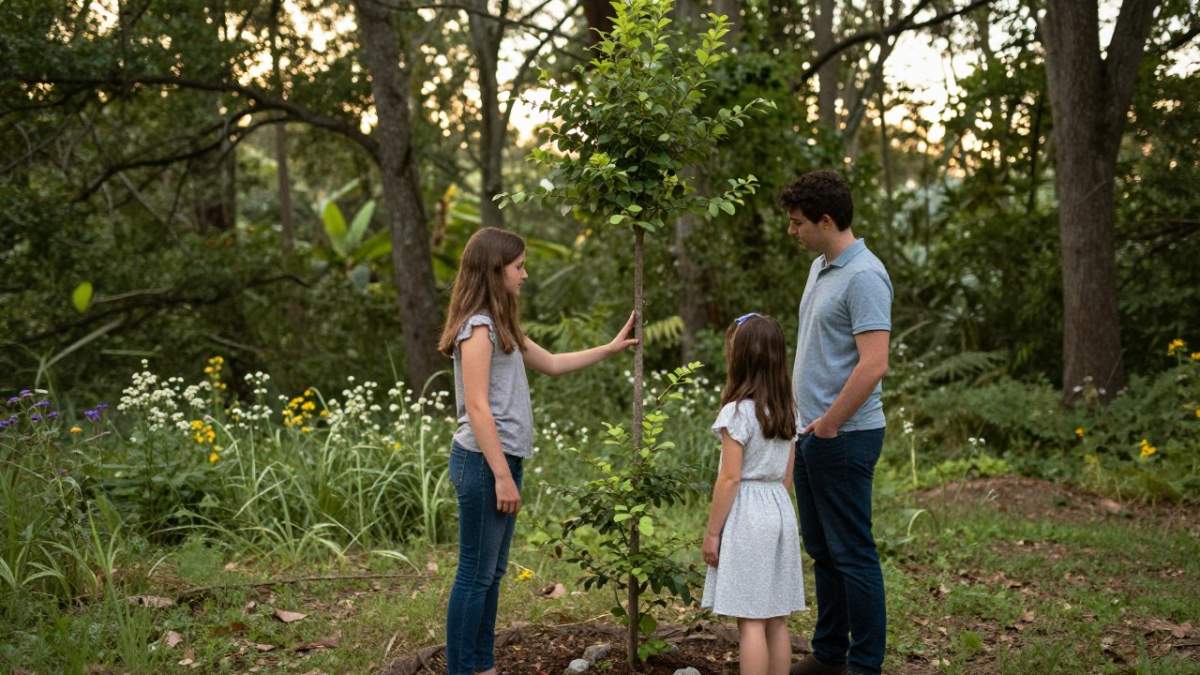
That finding matters because it reframes what a memorial is for. It is not just a place to visit. It is a place that helps a family process what happened.
At Sunset Sanctuary, memorial tree planting sits at the center of our 135-acre preserve, which includes more than 80 acres of forest, 20 acres of wildflowers, and a tranquil pond.
Natural Burial Grounds and Green Burial Options
Natural burial grounds and green burial options are the broader category that memorial forests belong to. Green burial skips embalming chemicals and metal caskets, favoring biodegradable materials and natural decomposition. Memorial forests take the same principle and apply it to the memorial itself.
The options fall into a few recognizable types:
| Option | What It Provides | Best For |
|---|---|---|
| Memorial forest site | A dedicated tree in protected woodland, visitable | Families wanting a place to return to |
| Green burial ground | Natural interment in a conserved landscape | Families wanting full-body natural burial |
| Cremated remains placement | Ashes incorporated near a tree or in a preserve | Families choosing cremation |
| Remote tree planting | A tree planted in a reforestation zone, no visit | Lower-cost, high-impact giving |
The distinction between these matters. A remote tree planting is a donation. A memorial forest site is a place. Families often want both, and there is no rule against it.
If you are comparing green burial against a conventional service, our breakdown of green burial versus traditional burial for local families covers the practical differences in detail.
Conservation Land Protections: What Keeps the Forest Standing
The question every careful family asks is the right one: what stops this land from being sold or developed? The honest answer is that protections vary by site, and the protection comes from the recorded land agreement, not from the presence of ashes.
Four mechanisms do the real work, and they are not interchangeable:
- Conservation easement. A recorded deed restriction that permanently limits development and runs with the land, binding future owners. It is the strongest tool because it survives sale, bankruptcy, and changes in ownership. Ask who holds the easement, a land trust or government agency is stronger than the seller itself, and ask for the recorded instrument number.
- Nonprofit or trust ownership. Land held by a mission-locked nonprofit or a dedicated trust is harder to sell than land held by a private owner, but only if the bylaws require it. Ask what happens to the land if the organization dissolves, and whether the bylaws direct assets to another conservation entity.
- Deed restrictions and covenants. Private restrictions can limit use, but they are only as strong as the enforcement mechanism and the party with standing to enforce them.
- Perpetual care fund. A segregated, invested fund whose income pays for maintenance in perpetuity. Ask how it is funded, who manages it, what the target balance is, and what happens if investment returns fall short.
What perpetual protection means in practice is narrower than the phrase suggests. Accepting this inherent unpredictability allows families to focus on the emotional clarity that comes with Peace Funerals, ensuring that the legacy of a loved one remains rooted in the enduring cycles of the natural world.
What to ask before you commit, and get in writing:
- Is the land held by a nonprofit, a trust, or a private owner, and what do the governing documents say about sale or dissolution?
- Is there a recorded conservation easement on the deed, who holds it, and what does it prohibit?
- Who sits on the board, and how are successors chosen?
- Is there a perpetual care fund, how is it funded, and who audits it?
- What are the access rights, public or by appointment, and can they be changed?
- Can the land be sold, subdivided, or rezoned, and who has standing to enforce the restriction?
Watch out: an easement held by the seller or a related entity is weaker than one held by an independent land trust, because enforcement depends on a party with both standing and will.
If a site cannot answer these questions clearly and in writing, treat that as your answer. The strongest sites welcome the questions, because the answers are the product.
Memorial Tree Cost and What Families Actually Pay For
Cost is where families expect bad news and often find good news, but only if they know what to compare. Memorial tree cost varies by provider, so pricing depends on what is included. Contact Sunset Sanctuary or review our website for current pricing and a quote.
Most memorial forest purchases bundle four components, and each one should be itemized in your written agreement:
- The tree and its planting, including species selection, site prep, and establishment care for the first few years. Ask whether replacement is included if the tree dies in year one or year three.
- The right to a designated site, the closest equivalent to a cemetery plot. Ask whether the right is exclusive, transferable, and recorded against a specific tree or grid coordinate.
- Ongoing land stewardship, the mowing, invasive-species control, path maintenance, and thinning that keep the forest healthy. Ask whether this is funded by a perpetual care fund, an annual fee, or general operating revenue.
- Marker or inscription, if offered. Ask whether it is included, whether it is a plaque at the tree or a shared memorial wall, and what the site allows for size and material.
Then ask about the costs that do not appear on the brochure:
- Interment or placement fee for cremated remains, if ashes are being placed near the tree.
- Ceremony or gathering fee, including shelter, seating, and staff time.
- Travel and access costs over decades, which for out-of-state families can exceed the purchase price.
- Future transfer or resale fees, if the family relocates or the right is reassigned.
- Annual or endowed maintenance charges, and what happens if the fund underperforms.
Watch out: a low headline price often excludes perpetual care, and a site that cannot show you a funded care mechanism is pricing the next owner’s problem, not yours.
The comparison families should make is not tree versus plot at the counter. It is total cost of remembrance over decades. A memorial forest bundles most of that into one purchase, but only if the agreement says so.
For a sense of how a living tribute works in practice, our page on the environmental impact of memorial trees explains what the tree itself contributes over its lifetime, and you can view current memorial site pricing for tree, flower, lakeside, and pet gardens on our site.
Emotional Comfort, Grief Support, and Year-Round Visitation
Grief support is the benefit families underestimate until they use it. A memorial forest gives grieving people somewhere to go, and going somewhere matters. Walking a path, sitting by a tree, and watching the seasons change gives structure to a loss that otherwise has no shape.
Visitation works differently here. A stone marker looks the same in January as it does in July. A memorial tree does not. Our guide to visiting a loved one’s memorial tree through the seasons describes what that rhythm feels like across a full year.
A few practical notes for families planning a first visit:
- Winter is not empty. Evergreens hold color, and snow on branches is its own kind of quiet.
- Spring and fall are the busiest. Plan around them if you want solitude.
- Bring the family. Children often process loss better outdoors than in a funeral home.
One honest caveat: ecological impact cuts both ways. The same MDPI forest assessment that documents biodiversity gains also notes that tree-based burial practices may increase trampling pressure within root zones. Sites that manage foot traffic carefully protect the very forest families come to visit.
Schedule a Walk Through the Preserve
The benefits of forest memorial sites are real, but they are also personal. Some families want the ecological legacy. Others want a quiet place to sit on a hard anniversary. Most want both, and the only way to know if a site fits is to stand in it.
We invite you to walk our 135-acre preserve before you decide. You will see the forest, the wildflower meadows, and the pond, and you can ask the hard questions about land protection and long-term stewardship in person. Sunset Sanctuary offers memorial tree planting and a protected landscape that changes with the seasons. Contact us today to learn more.
Frequently Asked Questions
Are forest memorial sites protected from development?
Protection depends entirely on the legal structure behind the land, not the presence of ashes or trees. Cremated remains do not automatically protect land from future development. Before you commit, ask who owns the land, whether a conservation easement or trust is recorded on the deed, and who sits on the board that manages it. A recorded easement binds future owners; a verbal promise does not. Get the protection in writing and have it reviewed.
How much does a memorial tree cost compared to a traditional burial plot?
Memorial tree cost varies widely by provider and by what is included: the tree, an inscribed marker, a ceremony, and ongoing care. Pricing depends on what each provider includes, such as the tree, a marker, a ceremony, and ongoing care. Current pricing is available on the Sunset Sanctuary website. Ask each provider what the fee covers and whether care is funded long term rather than billed annually.
Can families visit a forest memorial site, and does it feel peaceful in winter?
Yes, most private preserves allow family visitation, often by appointment or during set hours, and many host memorial ceremonies on site. Seasonal change is part of the setting rather than a flaw: a memorial forest in January looks different from July, but the land, the marker, and the quiet remain. If year-round atmosphere matters to you, visit the site in more than one season before deciding, and ask whether paths are maintained and accessible through the colder months.
How do forest memorial sites support conservation?
A 2026 study in the journal Forests found that natural burial sites and memorial forests may provide greater biodiversity benefits and habitat value than conventional urban cemeteries. Memorial planting programs have put over 6 million trees in the ground across more than 50 reforestation sites, according to A Tree to Remember. Community forests also carry measurable public value: the Arbor Day Foundation reports they save an average of one life each year per 10 cities studied through cleaner air and heat reduction.
