Natural Memorial Tree Planting in Minnesota: A Guide
Last Updated: October 30, 2026
Quick Summary
Natural memorial tree planting in Minnesota means honoring someone who has died by planting a native tree in a protected landscape instead of erecting a traditional headstone. Families choose the site, select a native species, plant during spring or fall dormancy, and arrange ongoing care for the first two to three years.
- Public forest donation programs start at a $10.00 minimum through the USDA Plant-A-Tree program.
- Seedlings from standard donation programs are not individually marked or designated as memorials.
- Planting in midsummer without irrigation is the most common way a memorial tree fails.
- Sunset Sanctuary’s 135-acre preserve includes over 80 acres of forest and 20 acres of wildflowers.
- Ask for a written conservation easement or deed restriction before committing to a site.
Table of Contents
- Why Natural Memorial Tree Planting Is Gaining Ground in Minnesota
- How to Plant a Tree in Memory of Someone: The Step-by-Step Process
- Memorial Tree Planting Options: From Backyard Saplings to Protected Preserves
- What a Memorial Tree Dedication Ceremony Can Look Like
- The Conservation Case: How Memorial Trees Support Minnesota Forests
- What Memorial Tree Planting Costs in Minnesota
- Protecting the Tree for the Long Term: Legal and Practical Questions
- Memorial Trees for Pets: A Quiet Place for Companion Animals
- What to Ask Before You Choose a Memorial Tree Provider
- Arranging a Memorial Tree Planting at Sunset Sanctuary
- Frequently Asked Questions
Why Natural Memorial Tree Planting Is Gaining Ground in Minnesota
Natural memorial tree planting in Minnesota is the practice of honoring someone who has died by planting a native tree in a protected landscape instead of erecting a traditional headstone. It is a living tribute, and it is spreading fast across the state. At Sunset Sanctuary, we hear the same thing from families again and again: they want a memorial that grows, not one that sits still.
The scale of tree planting here is remarkable. The Nature Conservancy is planting 3.2 million seedlings across northern forests this year to support recovery from disease and fire damage, according to The Nature Conservancy’s 2026 reforestation report. Memorial programs have contributed to that momentum; A Tree to Remember reports over 6 million memorial trees planted across more than 50 reforestation sites.
Why the shift? Three reasons stand out.
- Traditional burial costs continue to climb, and families increasingly question the environmental footprint of vaults and embalming.
- Minnesotans have a deep cultural attachment to the state’s forests and lakes.
- A tree gives grieving families somewhere to go that feels alive rather than final.
The conventional wisdom says a memorial needs a marker to be real. We disagree. A living tree is a more honest marker than granite, because it changes with the seasons the way grief does.
How to Plant a Tree in Memory of Someone: The Step-by-Step Process
Memorial tree planting follows a clear sequence: choose the site, select a native species, prepare the ground, plant during dormancy, and arrange ongoing care. Most families complete the planning in a few weeks and schedule planting for spring or fall.
Here is the process we walk families through:
- Decide on the setting. Backyard, public forest donation program, or a protected preserve with a dedicated memorial area.
- Confirm any permissions. Public land programs have their own rules; private land may need a family agreement.
- Pick the species based on your loved one’s preferences and the site’s soil and light conditions.
- Time the planting. Spring and fall give roots the best chance to establish before heat or hard frost.
- Plan the dedication, whether that is a quiet moment or a gathering of twenty people.
- Set up a care plan for watering and protection during the first two to three years.
Watch out: planting in midsummer without irrigation is the single most common way a memorial tree fails. A tree planted in July without a watering plan is a tree you may have to replant next spring.
Choosing the Right Species for Your Loved One
Species selection is where a memorial becomes personal. A bur oak for the grandparent who loved shade. Red maple for the family who camped every autumn. White pine for the person who grew up near the north woods.
Long-term University of Minnesota research on bur oak plantings shows that protective caging is essential during establishment to prevent deer and rabbit damage. That matters when you are choosing a species: a fast-growing tree that deer love may need more protection than a slower, tougher native.
You can explore the tree species planted at Sunset Sanctuary to see which native remembrance trees are available and how each behaves through the seasons.
Memorial Tree Planting Options: From Backyard Saplings to Protected Preserves
Memorial tree planting options fall into three broad categories: public forest donation programs, private preserve planting, and planting on your own land. Each offers a different level of permanence, access, and personal involvement.
| Option | Permanence | Can You Visit? | Best For |
|---|---|---|---|
| Public forest donation | Long-term forest health | No designated tree | Symbolic tribute, low cost |
| Private preserve | Protected landscape | Yes, designated area | Families who want a place to return to |
| Own property | Depends on the deed | Yes, at home | Families staying on the land |
Public Forest Donation Programs
Public programs are the simplest entry point. The USDA’s Plant-A-Tree program accepts a minimum donation of $10.00 for memorial seedlings in national forests, according to USDA Forest Service Plant-A-Tree program details. The catch is one most families do not learn until later: seedlings planted through standard donation programs are not individually marked or designated as memorials. They join the general forest ecosystem.
That is not a flaw. It is a different kind of gift. If you want a specific tree you can stand beside, a donation program will not give you that. If you want to support forest recovery at scale, it will.
Private Preserve Planting
Private preserves sit between the two extremes. You get a designated tree in a protected landscape, with a place to visit and a staff that manages the land long-term. Sunset Sanctuary’s 135-acre preserve includes over 80 acres of forest, 20 acres of wildflowers, and a tranquil pond. You can also sponsor memorial tree planting at Sunset Sanctuary.
What a Memorial Tree Dedication Ceremony Can Look Like
A memorial tree dedication can be as simple as one person saying a name aloud or as structured as a short service with readings, music, and a shared meal afterward. There is no required format, which is exactly what makes it work for families who never felt at home in a funeral parlor.
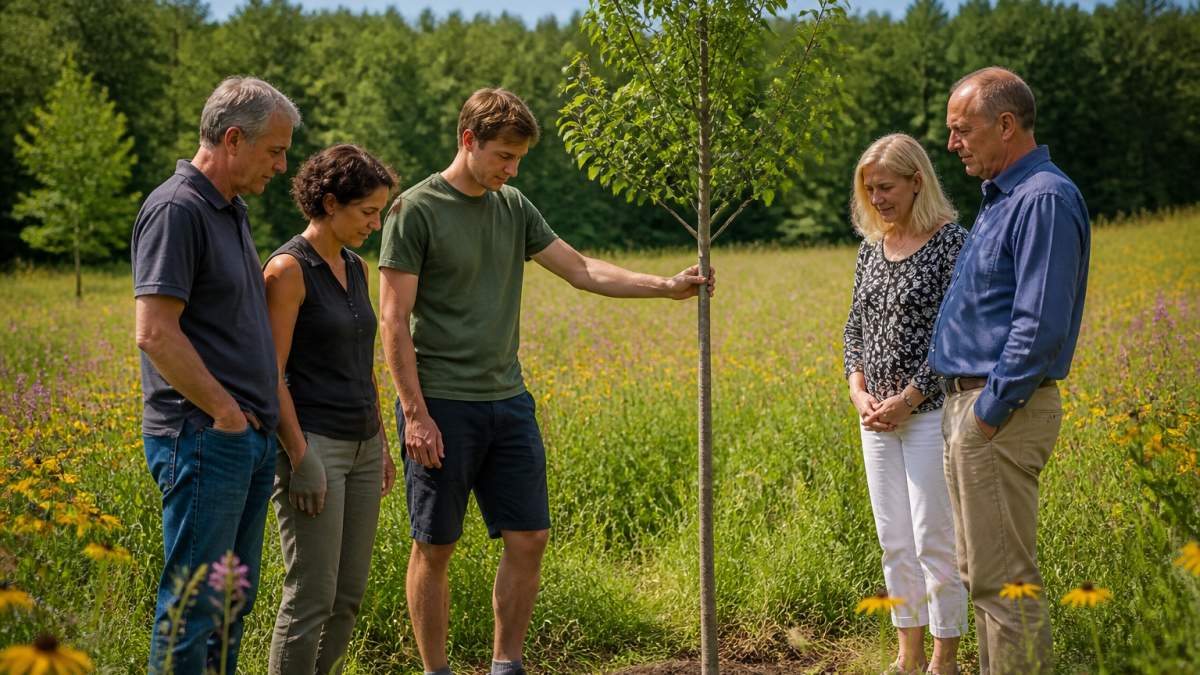
The elements families most often include:
- A brief reading or poem, chosen by the person who knew the deceased best
- A handful of soil placed at the base by each attendee
- A moment of silence timed to the season, longer in winter
- Photos or letters buried beneath the root ball, if the site permits
- A shared meal nearby, often the part people remember longest
One observation from the families we work with: the dedication matters less than the return visit. The ceremony is a beginning. The tree is what carries the memory forward.
The Conservation Case: How Memorial Trees Support Minnesota Forests
Memorial trees support conservation because they add native canopy to landscapes that need it, and the scale of that contribution is measurable.
Minnesota’s Field to Forest Cost-Share Program offers up to 75% reimbursement for large-scale tree planting projects, according to Minnesota Field to Forest cost-share program. That public investment signals how seriously the state treats reforestation. Private memorial planting complements it on smaller, more personal parcels.
The ecological argument is straightforward. Native trees stabilize soil, filter runoff, provide wildlife habitat, and sequester carbon over decades. A memorial grove does all of that while giving a family a reason to care about a specific patch of ground. Conservation that people feel personally attached to tends to last longer than conservation done at arm’s length.
What Memorial Tree Planting Costs in Minnesota
Memorial tree planting costs vary widely by option. A public forest donation starts at the $10.00 minimum set by the USDA Plant-A-Tree program. A professional memorial tree planting service, by contrast, can start around $1,350 for a 7-to-14-foot tree, based on NWI Tree Service memorial planting pricing. Private preserve planting sits somewhere between, depending on species, site, and services included.
Pricing depends on several factors. What drives cost:
- Tree size and species
- Whether the site requires site preparation or irrigation
- Dedication services and any permanent record or locator
- Ongoing care included in the arrangement
You can view current pricing for tree, flower, lakeside, and pet garden options on our pricing page.
Protecting the Tree for the Long Term: Legal and Practical Questions
Permanence is the question every family should ask, and most do not ask it early enough. A memorial tree is most meaningful when the land it stands on stays protected.
The practical questions to raise before you commit:
- Who owns the land, and what happens if it changes hands? Ask for the conservation easement or deed restriction in writing.
- Who is responsible for care? A tree needs watering, mulching, and protection for its first years.
- What happens if the tree dies? A reputable provider will have a replacement policy.
- Is the arrangement recorded? GPS locators and registry entries make a tree findable decades later.
A memorial tree without a land protection agreement is a hope, not a plan. Ask for the paperwork.
Memorial Trees for Pets: A Quiet Place for Companion Animals
Memorial trees for pets follow the same principles as memorials for people: a native tree, a protected site, and a place to return to. The grief is real, and it deserves the same care.
More families than you might expect are choosing this. A pet memorial tree gives children a way to understand loss, gives adults a ritual that does not feel clinical, and gives the animal a resting place that is not a shelf.
If you are looking for an affordable place to scatter a pet’s ashes near you, Sunset Sanctuary offers options for companion animals.
What to Ask Before You Choose a Memorial Tree Provider
Before you choose a provider, ask five questions: who owns and protects the land, what species are available, what care is included, what happens if the tree dies, and what record you receive. A provider that cannot answer all five clearly is not ready for your family.
Our shortlist of what separates a serious provider from a casual one:
- A written land protection agreement, not a verbal promise
- Native species suited to the site, not whatever is cheapest
- A care plan that extends past the planting day
- A locator or registry so the tree can be found years later
- Clear pricing published up front
What most guides miss is the land question. A beautiful site with no protection is a site that could be sold. Ask for the easement.
Arranging a Memorial Tree Planting at Sunset Sanctuary
Arranging a memorial tree planting starts with a conversation about the person you are honoring, then moves to species, site, and timing. We keep the process slow enough to be meaningful and simple enough to be manageable during a difficult season.
At Sunset Sanctuary, memorial planting is built into a 135-acre preserve with over 80 acres of forest, 20 acres of wildflowers, and a pond, all managed for long-term conservation. Families can choose a memorial tree and plan a dedication, with a place to return to as the landscape changes with the seasons. If you are ready to plant a remembrance tree at Sunset Sanctuary, we will walk you through species, site, and timing.
Frequently Asked Questions
What is natural memorial tree planting?
Natural memorial tree planting is the practice of planting a tree as a living tribute to someone who has died, usually on protected land rather than in a cemetery. Instead of a headstone, the tree becomes the marker and the memorial grows with it. In Minnesota, options range from a $10 donation through the USDA Plant-A-Tree program, where seedlings are added to national forests without individual designation, to planting on a private preserve where the tree is tied to a specific location and ceremony.
Can you choose the tree planted in memory of a loved one?
It depends on the program. Public donation programs typically select species based on what the forest needs, so you cannot pick. Private preserves usually let families choose from native species suited to the site. When choosing, match the tree to the soil and light conditions, not just sentiment. A bur oak suits open ground and lives for centuries, while a red maple prefers moisture. Ask whether the provider protects the sapling from deer and rabbit damage during establishment.
How long does a memorial tree last?
A properly sited native tree can outlive the family that planted it. Native species such as bur oak and white pine can live for many decades. The first two to three years are the vulnerable period, when watering and browse protection decide whether the tree establishes. After that, a native tree on protected land needs little intervention. Longevity depends far more on site protection and species choice than on the planting itself, which is why the legal status of the land matters as much as the tree.
How can a memorial tree planting support conservation?
Memorial plantings add to the state’s reforestation totals. A memorial planting on a protected preserve contributes to the same goals at a smaller scale, and it keeps the land in forest rather than converting it. Ask any provider how the planting fits their land management plan.
What should you ask before arranging a memorial tree planting?
Ask who owns the land and what legally prevents it from being sold or developed. Ask whether the tree is individually designated or folded into a general planting. Ask who maintains it, who caged it against deer, and what happens if it dies in year one. Ask whether pets are included and how far in advance a ceremony must be scheduled. Get the answers in writing, and confirm whether pricing covers planting, a marker, and ongoing care or bills them separately.
The hardest part of memorial planning is often the first phone call. If you want a memorial that grows, supports conservation, and gives your family somewhere to return to year after year, Sunset Sanctuary can help you arrange a native tree planting on protected land, plan a dedication that fits your family, and secure a record of the site for the future. Get started with Sunset Sanctuary and create a living tribute that lasts for generations.
